
Scuba Diving FAQ: Everything You Need to Know About Diving in Tamarindo
Real questions about diving in Tamarindo and at the Catalina Islands, answered directly: marine life, manta ray and whale season, local diving conditions, and getting certified. Wildlife is wild: sightings mentioned below are commonly reported, never guaranteed.
Diving in Tamarindo and the Catalina Islands
The Catalina Islands (Islas Catalinas) are the main dive destination for boats leaving Tamarindo, a chain of volcanic islets in the Gulf of Papagayo known for strong currents and rich marine life.
Fun Dive · Las Catalinas All Tamarindo diving experiences
The Catalina Islands are a chain of about twenty volcanic islets in the Gulf of Papagayo, off Costa Rica's Guanacaste coast. Dive boats reach them from Tamarindo in around 40 minutes.
Not formally. Unlike the Bat Islands (Islas Murciélago), which fall within the Marine Sector of the SINAC-managed Área de Conservación Guanacaste (a UNESCO World Heritage Site), the Catalina Islands do not currently carry that same protected-area designation. They are a naturally rich dive site, not a classified protected area.
Catalina Islands dive sites range from about 10 to 30 metres (33 to 100 feet) deep and suit a range of experience levels, from supervised beginners to more advanced divers, without the depth and current demands of sites like the Bat Islands.
About 40 minutes from Tamarindo, depending on sea conditions.
Marine Life Around Tamarindo
Guanacaste's Pacific waters support a wide range of species, from resident reef life to migratory visitors passing through seasonally.
Divers in the Tamarindo area may encounter whitetip reef sharks, eagle rays, sea turtles, pufferfish, moray eels, and large schools of tropical fish, among other species typical of Guanacaste's Pacific reefs.
The Catalina Islands are known for a dense concentration of marine life, including whitetip reef sharks, eagle rays, devil rays, cownose rays, sea turtles, moray eels, pufferfish, octopus, seahorses, and large schools of jacks.
Manta Rays and Mobula Rays
Manta and mobula rays are among the most sought-after sightings on Costa Rica's Pacific coast, and their movements are the subject of ongoing scientific research.
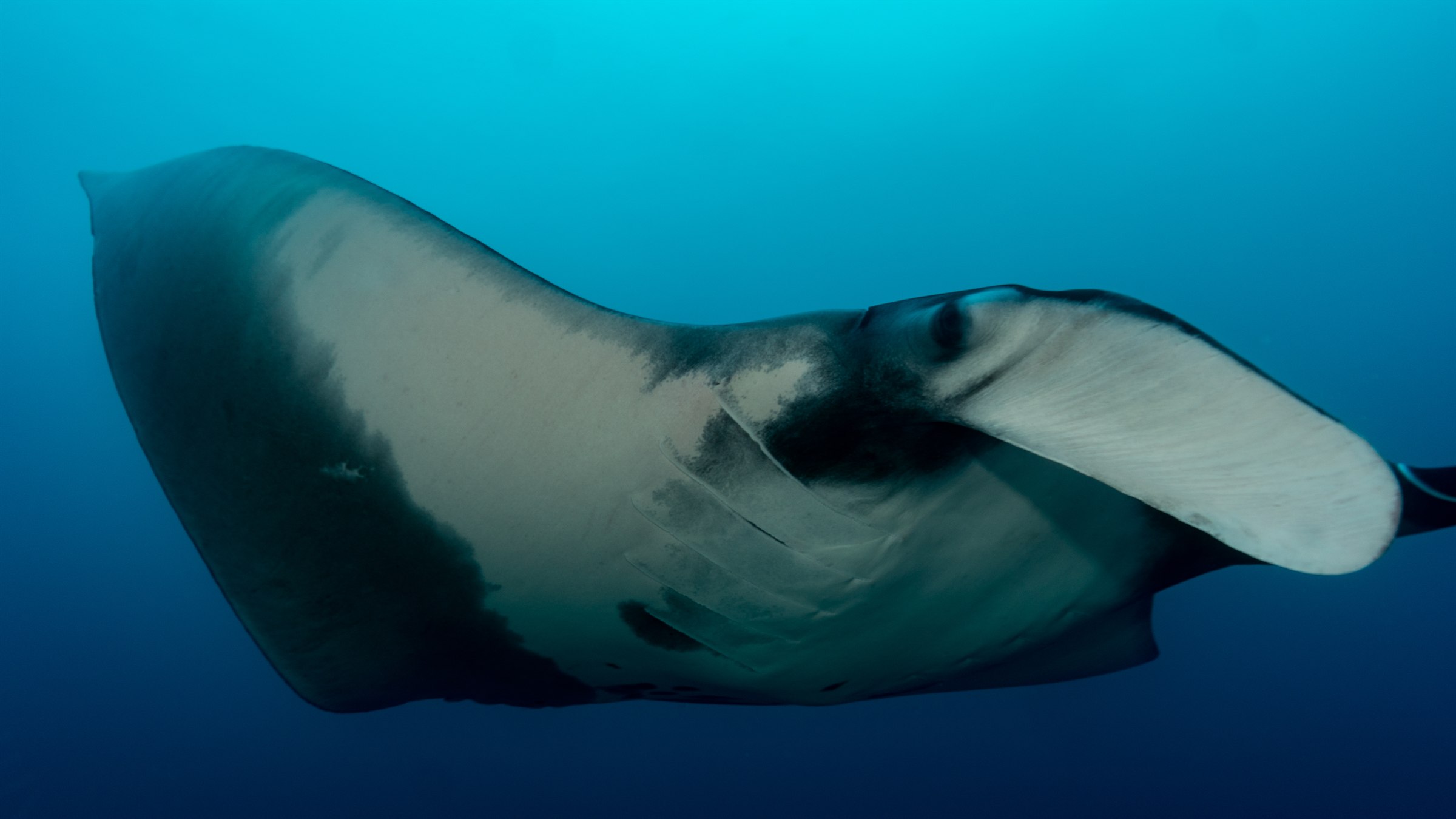
Divers may encounter manta rays and sea turtles in the Tamarindo area. Manta ray sightings are most commonly reported from December to May, though as with all wildlife, encounters depend on season and natural conditions.
The Catalina Islands are a commonly reported sighting location for giant oceanic manta rays (Mobula birostris), the world's largest ray, with a wingspan of up to 8 metres (26 feet). Sightings along Costa Rica's Pacific coast are most commonly reported from December to May. Their movements are tracked by the Mantas Costa Rica project, affiliated with the international Manta Trust / MigraMar research network, using acoustic telemetry and photo identification. As with any wild animal, a sighting is never guaranteed on a given dive.
Whale Season in Guanacaste
Costa Rica's position in the Pacific gives it an unusually long humpback whale season, drawing two separate migratory populations.
Two distinct humpback whale populations pass through Costa Rican waters to breed and calve: one from the North Pacific, present December to March, and one from the Southern Hemisphere, present July to mid-November, one of the longest migrations recorded for the species. Whale activity is possible in Guanacaste waters across much of the year, though sightings are opportunistic rather than a planned part of any dive.
No. Whales, manta rays, and all other marine wildlife are wild animals, and encounters depend on natural conditions, animal movement, and season. Sightings are commonly reported at certain times of year, but no dive operator can guarantee them on any single trip.
Pacific Ocean Diving Conditions
Diving conditions off Guanacaste change noticeably between Costa Rica's two seasons, driven partly by a well-documented regional upwelling system.
December–May
Best for: Oceanic manta rays (peak season), eagle rays, reef sharks.
June–October
Best for: Warm water, abundant marine life, schooling fish, turtles, occasional mantas. Bonus: Humpback whales migrate through Costa Rica's Pacific coast during parts of this season, and whale songs can sometimes be heard underwater.
Water temperature in the Gulf of Papagayo stays warm most of the year, generally in the 25-30°C range, with a milder, slightly cooler spell possible during the dry season upwelling.
The Gulf of Papagayo is one of a small number of seasonal wind-driven upwelling zones in the region. During the Northern Hemisphere winter, strong winds funnel through gaps in the Central American mountain range and push surface water offshore, drawing cooler, nutrient-rich water up from depth. This process, documented by oceanographic research in the Gulf of Papagayo, is part of what supports the area's marine productivity, alongside cooler water temperatures during the dry season.
Bat Islands and Bull Sharks
The Bat Islands (Islas Murciélago) are a separate, more advanced dive site from the Catalina Islands, best known for bull shark encounters.
Yes. The Bat Islands (Islas Murciélago), part of the Marine Sector of SINAC's Área de Conservación Guanacaste, are one of the few places in the world with regular bull shark encounters. A study published in the Revista de Biología Tropical documented a high residency index for bull sharks at the San Pedrillo Islet dive site within the archipelago, confirming it as an important aggregation site for the species.
Bat Islands trips generally run from May to November.
Yes. Diving at the Bat Islands is reserved for certified Advanced Open Water divers, given the depth and current conditions at the site.
The boat leaves from Tamarindo and the ride takes about 2 hours, depending on sea conditions.
Dives at the Bat Islands average around 25 metres (80 feet), with a maximum of about 30 metres (100 feet). Together with the currents, this is why the site is reserved for certified Advanced Open Water divers.
Bull shark dives require an appropriate certification level because the site can be deep and affected by strong currents. Encounters are completely unbaited, and the sharks naturally gather at a cleaning station, where smaller fish remove parasites and dead skin from their bodies. Although diving with large sharks always requires caution and strict safety procedures, no shark-related incidents have been recorded at this dive site.
Scuba Diving for Beginners
No experience or certification is needed to try scuba diving for the first time in Tamarindo.
No. The Discover Scuba Diving experience requires no prior certification or experience.
It starts with a private briefing with a PADI instructor, followed by two guided dives of roughly 45 minutes to 1 hour each. A pool session is also possible on demand before heading out to the ocean.
10 years old, for both the Discover Scuba Diving experience and the Open Water Diver course.
No competitive swimming ability is required; being comfortable in the water is enough.
For non-certified divers, depth is limited to a maximum of 12 metres, kept within what feels comfortable for the diver and adjusted continuously by the instructor.
PADI Certifications and Courses
Salty Horizon teaches the PADI Open Water Diver and Advanced Open Water Diver certifications in Tamarindo: see the full PADI Courses page for schedules and requirements.
3 days: theory and pool sessions followed by 4 open water dives at the Catalina Islands.
The course starts at $540.
Theory course, pool session skills, 4 ocean dives at the Catalina Islands, all equipment, PADI certification fees, and snacks and drinks.
It's for divers already certified as Open Water Diver who want to build confidence and extend their depth limit to 30m/100ft, through 5 adventure dives.
The course starts at $500 and can be completed in 2 or 3 days.
Open Water Diver is the entry-level certification, with a maximum depth of 18m. Advanced Open Water builds on it with mandatory Deep and Navigation dives, plus elective specialty dives, extending the depth limit to 30m.
Yes, and it's recommended to save time once you arrive.
Health and Safety
Common health and safety questions from first-time and returning divers.
Diving is a safe activity when practiced within standard training protocols, which is why a medical form and supervision by a certified PADI instructor are required for every course.
Yes, for the Discover Scuba Diving, Open Water and Advanced Open Water courses you need to confirm you are medically fit to dive; a medical form is available to download and must be completed before the course.
In many cases yes, if it is well controlled, but medical clearance is required; this should be discussed with a doctor before your trip.
Not with glasses directly, since they don't fit under a mask, but contact lenses or a prescription dive mask both work well.
It's possible in rougher conditions; guidance is given before departure and boat rides to local sites are short.
Shark-related incidents are extremely rare, and bull shark encounters at the Bat Islands take place without any feeding, at a respectful distance.
Planning Your Dive in Tamarindo
Practical details for booking and preparing for a dive with Salty Horizon.
Through the booking form on this site, confirmed personally over WhatsApp.
A deposit is required to confirm every booking (the amount depends on the activity). If you cancel: 100% refund 7 days or more before the activity, 50% refund between 3 and 6 days before, and no refund less than 72 hours before or for a no-show. If we cancel because of weather, safety concerns or operational circumstances beyond our control, or because the minimum number of participants for a shared activity isn't reached, you can choose to reschedule or get a full refund. No refund is issued if you can't take part because you don't meet the medical, fitness or certification requirements, or didn't disclose relevant information in advance. Booking changes are subject to availability and our approval.
With Salty Horizon you will always have a private guide for you or your group.
Yes. Camille and Julien are trilingual and teach and guide in all three languages.
A swimsuit and towel; all scuba equipment is provided.
Snorkeling and Private Charters
For non-divers or a custom day at sea, see the full Private Charters page.
Yes, private snorkeling sessions, two outings of 45 minutes to 1 hour, starting at $90.
Yes, a fully customized day at sea combining scuba, snorkeling, paddle boarding, e-foil and jet ski.
A flexible itinerary built around what you want to do on the water, organized around your group.